Adapted from reporting by Skip Anderson, MSU News Service
Montana State University officially opened QCORE (Quantum Collaborative Research and Education) on August 20, 2025, marking a major milestone in the university’s efforts to advance quantum research, education, and innovation. Housed in MSU’s College of Letters and Science, QCORE is an interdisciplinary research facility designed to identify and address grand challenges in quantum systems.
Located in the EngineWorks building on MSU’s Innovation Campus, the 12,600-square-foot facility positions Montana State University as a national and global leader in applied quantum research—bringing together academic researchers, industry partners, government agencies, and emerging talent under one roof.
A Landmark Opening for QCORE
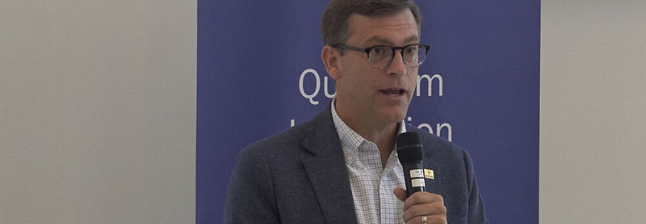
QCORE’s official opening was marked by a ribbon cutting ceremony that also kicked off the three-day Grand Challenges in Quantum Systems Summit, hosted by QCORE beginning August 20. The summit brought together faculty, students, industry leaders, government representatives, and partners from across the United States and around the world.
An open house followed on Friday, August 22, welcoming the public to explore the facility and learn more about the research and technologies shaping the future of quantum systems.
Speaking at the opening ceremony, MSU President Brock Tessman emphasized the broader significance of QCORE for both Montana and the nation:
“As I think about myself as the president of Montana State University, I’m so excited by the fact that we are positioned as a global leader in quantum. And as I think about myself as a Montanan or an American, I’m thrilled and proud because of the way quantum can position us so that we can better protect Montana food security, productivity, homeland security and national security interests overseas. All of that is a reflection of the work that occurs through this partnership.”
Addressing Grand Challenges in Quantum Systems
The Grand Challenges in Quantum Systems Summit featured keynote addresses from Michael J. Hayduk, Deputy Director of the Information Directorate at the U.S. Air Force Research Laboratory (AFRL), and Jacob Taylor, adjunct professor of physics at the Institute for Advanced Computer Studies at the University of Maryland.
The summit also included panel discussions and technical presentations from more than 25 speakers, representing academia and industry from Montana and around the world, with participation from approximately 35 companies and organizations. State and local leaders, including representatives from the Montana Department of Commerce and the City of Bozeman, also took part—underscoring QCORE’s role in Montana’s broader innovation and economic development strategy.
According to Dr. Jayne Morrow, Director of QCORE, the summit was designed to unite partners and stakeholders around the most pressing challenges in quantum systems—areas where MSU’s ecosystem is uniquely positioned to drive solutions.
Building World-Leading Quantum Infrastructure
QCORE’s origin traces back to $44.7 million in funding from the U.S. Air Force Research Laboratory, which helped establish the facility and its advanced capabilities. Additional AFRL support, including a $26.7 million grant awarded in 2023, enabled MSU to acquire specialized equipment for testing prototype quantum components in the ultra-cold environments required for quantum operation.
Today, QCORE represents a rare concentration of quantum infrastructure:
- The world’s first university to host an on-site Rigetti Novera superconducting quantum computer
- The first university in the United States with an ORCA photonic quantum computer
- One of only five quantum network testbeds worldwide
- One of only seven organizations globally to house both photonic and superconducting quantum systems
This unique combination of systems enables researchers and innovators to test experimental components, explore multiple quantum modalities, and accelerate next-generation hardware design and development.
Advancing Quantum Science and Real-World Applications
Quantum physics examines the behavior of particles smaller than atoms—phenomena that enable faster, more precise, more sensitive, and more secure technologies. Researchers at MSU’s Spectrum Lab and MonArk Quantum Foundry, both part of QCORE, are advancing quantum-enabled solutions for electronics, sensors, navigation systems, computing, and medical equipment.
Two of the major challenges facing quantum computing today are hardware scale and energy consumption. Addressing these challenges requires deep technical expertise in hardware systems—an area where Montana State University’s strengths in photonics, cryogenics, and systems engineering position QCORE to make meaningful contributions.
Over the past two decades, MSU has helped establish a growing network of photonics and cryogenics companies in and around Bozeman. These companies are expected to play a critical role in advancing quantum research, commercialization, and workforce development across Montana.
From Research to Community Impact
A core part of QCORE’s mission is research translation—supporting scientists and entrepreneurs as they transform quantum advances into useful components, devices, and companies. QCORE provides startup incubation, workforce education programs from K–12 through graduate education, and direct engagement with industry partners.
To date, QCORE has signed sponsored research agreements or memoranda of understanding with 15 companies, helping connect emerging technologies with real-world applications.
QCORE’s outreach also extends beyond traditional research pathways. The program has distributed quantum education kits to more than 70 schools across Montana, equipping teachers with resources to introduce students to quantum systems. QCORE has also partnered with artists statewide, supporting creative projects such as Sunprints, which harness quantum mechanics to produce visual art.
Art and Science at QCORE
The QCORE facility features an art installation titled “The Shape of Uncertainty,” created by MSU senior Jack Schnepf, who is graduating with a Bachelor of Fine Arts in studio arts. The installation reflects the intersection of creativity and quantum science, reinforcing QCORE’s interdisciplinary approach to discovery and innovation.
Looking Ahead
With the opening of QCORE, Montana State University strengthens its position as a national leader in applied quantum research, education, and commercialization. By combining world-class infrastructure, public–private partnerships, workforce development, and community engagement, QCORE is building a quantum ecosystem designed to deliver lasting impact—for Montana and beyond.
As President Tessman noted during the opening ceremony:
“The future is yet to be written. Many of the people who will write that future are in this room today.”