QCORE Seminar Series · October 29, 2025
Featuring Martín Mosquera PhD
📄 Access the full slide deck
Why We Hosted This Talk
Neutral atom quantum computing is one of the fastest-growing platforms in quantum information science, and Rydberg atoms sit at the center of its most exciting advances. Yet the physics behind these systems quickly becomes challenging—not just because the experiments are sophisticated, but because the quantum states involved can become too complex for classical computers to fully predict.
In this QCORE seminar, Martín A. Mosquera introduced the audience to the electronic structure challenges underlying Rydberg atom platforms and explained why quantum chemistry—often viewed as its own specialized discipline—may provide essential tools for modeling and correcting errors in these emerging quantum systems.
His talk offered a rare bridge between experimental quantum computing and theoretical chemistry: a discussion of how rigorous electronic structure theory and diagrammatic methods can help predict and understand small clusters of Rydberg atoms, especially in non-equilibrium conditions.
About the Speaker

Martín Mosquera PhD
Martín A. Mosquera is an Assistant Professor in the Department of Chemistry and Biochemistry at Montana State University. His work spans quantum information science, transition metal complexes, and electronic structure theory development. His lab focuses on building theoretical methods that use the fundamental constants of physics to predict molecular and atomic behavior with high accuracy—particularly in quantum regimes where conventional approximations break down (slide 1).
An Informal Talk—With a Serious Goal
Martín begins by setting a relaxed tone. He describes the talk as informal—possibly one of the most informal in the QCORE series—before immediately revealing the deeper challenge: presenting quantum chemistry to an audience that includes physicists.
He jokes that quantum chemists are “the combination of two evils,” and admits that physicists make him nervous because they are difficult to convince. But the humor is paired with a clear purpose: the work he describes is not abstract theory for its own sake, but a pathway toward understanding quantum systems that classical computers struggle to simulate.
He introduces his broader research interests early: quantum information science on one side, and transition metal complexes and biomolecular systems on the other. Across both, the central theme remains consistent—developing electronic structure methods that can predict behavior from first principles (slides 1–2).
What Quantum Chemistry Is Trying to Do
Martín frames the goal of quantum chemistry in the simplest possible terms: using the fundamental constants of physics—Planck’s constant, the electron mass, and related quantities—to predict the behavior of matter.
He notes that this is conceptually elegant but computationally difficult, because electron interactions are inherently complex. Chemistry may be an old field, but the electronic structure problem remains a modern challenge. As he puts it, quantum chemistry is essentially the application of quantum mechanics to chemical reactions, and it is roughly a century old—but still full of unresolved issues (slides 2–3).
This is where his talk begins to connect directly to quantum information science.
Neutral Atom Quantum Computers: A Platform Built from Atoms
Martín shifts to a major motivation: neutral atom quantum computing. He explains that many quantum computing architectures are complicated black boxes to most audiences, and even experts struggle to intuitively grasp their internal behavior.
But neutral atom quantum computers can be explained more concretely: they involve trapping and cooling neutral atoms, placing them in carefully designed arrays, and then using lasers to drive quantum dynamics.
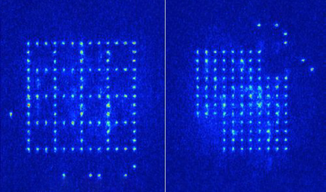
He emphasizes that the field has advanced significantly—experimentalists can now place neutral atoms in almost any configuration, in two-dimensional or three-dimensional arrangements, essentially creating a synthetic lattice or crystal. These atoms are often spaced micrometers apart, and the geometry can be customized (slides 4–5).
This flexibility makes neutral atom platforms both powerful and experimentally rich.
What Are Rydberg Atoms?
Martín then defines the key concept: Rydberg atoms.
A Rydberg atom is not a special kind of element—it is any atom whose electron has been excited to a very high-energy orbital, far from the nucleus. The electron is now in an “outer orbit,” and because it is so far from the ionic core, the atom’s properties change dramatically.
He explains that common candidates for these experiments include atoms like cesium, rubidium, strontium, ytterbium, and others. The Rydberg state is created by exciting an electron using lasers, often through intermediate orbital states (slides 6–7).
These highly excited states are not just physically interesting—they are computationally useful.
Why Rydberg Atoms Matter for Quantum Computation
Martín describes how Rydberg atoms enable quantum entanglement through controlled excitation. When atoms are close enough and driven by tuned laser pulses, they can enter entangled quantum states where the excitation is delocalized: it becomes unclear which atom is in which orbital until measurement occurs.
This is where the “magic” appears. These systems can reach entangled states that classical computers cannot easily represent, which is why they are considered candidates for quantum advantage.
Martín emphasizes that entanglement arises naturally in these platforms and that the resulting quantum states can become extremely complicated, very quickly (slides 7–8).
And then he makes an important observation from his perspective as a chemist:
To him, these clusters of atoms resemble molecules.
A Quantum Chemist’s Perspective: “This Looks Like a Molecule”
Martín explains that when he looks at Rydberg atom arrays, he sees a familiar structure: interacting particles with complicated electronic states.
From the quantum chemistry perspective, molecules are already systems of interacting quantum particles, and chemists have spent decades developing methods to model small collections of atoms with high accuracy.
This motivates the central idea of his talk: while it may be impossible to simulate a full-scale neutral atom quantum computer using classical computation, it may be feasible to model small clusters—dimers, trimers, tetramers, or slightly larger groups—using advanced quantum chemistry methods (slides 8–9).
These small clusters are experimentally feasible and can serve as testbeds for theory development.
Why Small Clusters Matter: Error and Noise
Martín points out that even in small experimental systems, entanglement is accompanied by noise. When experimentalists measure the state of atoms in a cluster, they see distributions: expected outcomes appear, but so do interfering states that act as unwanted noise.
He emphasizes that if theoretical methods can predict the structure of that noise, then error correction becomes more realistic. The ability to model small subsystems could ultimately help researchers understand and reduce errors in larger arrays (slides 9–10).
This is one of the key motivations behind his work: prediction as a pathway to correction.
The Hard Problem: Non-Equilibrium Quantum Dynamics
Martín then moves into a deeper theoretical issue.
He explains that physics and chemistry have made major progress in describing systems at equilibrium—especially systems at zero Kelvin or ground-state conditions. But neutral atom quantum computers do not operate at equilibrium. They involve entangled states, laser-driven dynamics, and non-trivial initial conditions.
The challenge is that existing diagrammatic methods in quantum chemistry are not fully developed for non-equilibrium electronic dynamics on general initial states.
Martín describes his work as addressing exactly this gap: developing methods for the non-equilibrium dynamics of electrons, based on connected Feynman diagrams (slides 11–12).
The “Movie Theater Problem”
To illustrate the combinatorial explosion of quantum states, Martín introduces an analogy.
A half-filled movie theater has an enormous number of possible seating arrangements. Even if the room is only partially occupied, the number of configurations becomes gigantic.
He explains that this is exactly what happens in quantum lattices: the number of possible quantum states grows so quickly that classical computers cannot handle them. This is one reason quantum computing is appealing—because the quantum system can “contain” these states naturally.
However, Martín notes that there are special cases where the problem is more manageable: smaller systems, constrained occupancy, or simplified lattice models. These become test cases for theory development (slides 12–13).
Coupled Cluster Theory and the Exponential Operator
Martín then introduces a major tool in quantum chemistry: Coupled Cluster (CC) theory.
He explains that CC theory is built around an exponential operator, which takes a simple reference state and systematically adds contributions from across the Hilbert space. This exponential structure is part of why coupled cluster methods can achieve extremely high accuracy.
He notes that quantum chemists are obsessed with precision—often aiming to predict energies as close as possible to experimental values. He references cases where fifth-order excitations combined with relativistic and quantum electrodynamics corrections can reproduce experimental energies very closely (slides 14–15).
But he stresses a limitation: these successes are strongest in equilibrium settings. Extending this to Hubbard-like lattice systems and non-equilibrium dynamics remains an open problem.
A New Approach: Infinitesimal Displacements
Martín describes his contribution as returning to fundamentals and deriving a new family of equations using the idea of infinitesimal translations—an approach inspired by operator transformations in physics, including ideas reminiscent of Lorentz-type transformations.
He explains that the goal was to create a theory that:
- produces linked diagrammatic expressions,
- propagates both ground and excited states,
- is systematically improvable,
- and is exact at all orders in principle.
He emphasizes that the method uses connected Feynman diagrams but is not simply perturbation theory in the naive sense (slides 16–18).
This is the conceptual foundation of the framework he has been developing.
Testing the Theory on a Small Model System
To validate the theory, Martín describes applying it to a simplified system: a three-electron, three-level model system resembling a Hubbard Hamiltonian.
He explains that by changing initial conditions—ground state, excited state, linear superposition, or other quantum states—it becomes possible to test whether the framework correctly predicts populations, coherences, and time-dependent observables under laser-driven perturbation.
He shows that the theory reproduces exact results for these test systems, including time-dependent behavior, and describes how earlier deviations were later corrected (slides 19–22).
The result is a method capable of predicting: populations, coherences, electric moments, magnetic moments, energies, and time-dependent evolution, for systems with general initial states.
The Long-Term Goal: Predicting Rydberg Atom Clusters
Martín then connects the theory back to the original motivation: Rydberg atoms.
He explains that the long-term goal is to compute, with very high accuracy, the electronic structure not only of a single Rydberg atom, but also of small clusters—dimers, trimers, tetramers, and beyond.
He frames this as something experimentalists could eventually use to predict outcomes of advanced experiments, or to better understand the noise structures that appear during entanglement generation.
He also mentions that quantum computation can occur even in extremely small systems, including experiments that have performed computation using a single atom, which underscores how valuable precise modeling could become (slides 23–24).
Current Research Directions in the Mosquera Lab
Martín closes the formal portion of the talk by describing several active research directions in his group, including: symmetry breaking studies, exact calculations of small atom clusters,
spectra of rubidium clusters, Hamiltonian theory of lattices, and future real-atom simulations.
He credits students and collaborators working on these topics and emphasizes that these problems remain open and rich with opportunity (slides 25–26).
He concludes with acknowledgments to his group, sponsors, and supporting organizations including the Department of Energy and the MonArk Quantum Foundry (slides 27–28).
Q&A Highlights
Q1 — Are Feynman diagrams inherently perturbative?
A: Martín explains that while diagrams are often associated with perturbation theory, the framework he is describing is not perturbative in the usual sense. The coupled cluster approach converges systematically toward the exact answer, and in certain systems the truncation of the expansion becomes mathematically exact. He emphasizes that the key lies in how commutators reduce operator complexity until only numerical terms remain.
Q2 — Is the method truly exact in practice?
A: Martín clarifies that the theory is exact only if solved to all orders, which is not feasible computationally. In practice, truncations are necessary. However, the method is systematically improvable, meaning that higher-order excitations push results closer to the correct solution.
Comment from the audience:
One participant adds that while perturbative diagram expansions often miss non-perturbative effects, certain diagrammatic methods can encode much richer information. They note that Martín’s framework is remarkable because it builds in this richness from the beginning, allowing diagrammatic representations while capturing more than standard perturbation theory.
| Ask Martín Have a question about Rydberg atoms, electronic structure theory, or how quantum chemistry connects to neutral atom quantum computing? Submit your question, and it may be featured in a future QCORE response. ➜ Submit a question |