
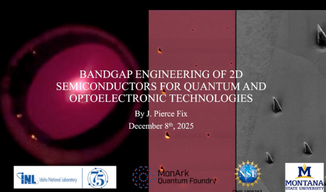
QCORE Seminar Series · December 8, 2025
Featuring J. Pierce Fix, Ph.D.
📄 Access the full slide deck
Why We Hosted This Talk
At QCORE, we are especially interested in research that sits at the boundary between discovery and design — work that does not merely observe new phenomena, but begins to ask how those phenomena might be controlled, reproduced, and eventually engineered. In quantum and optoelectronic materials, that boundary is often defined by how well we understand — and can manipulate — a material’s electronic structure.
In this seminar, Dr. J. Pierce Fix explored how researchers can deliberately reshape the electronic band structure of low-dimensional materials to create quantum emitters, a class of solid-state systems capable of emitting single photons on demand. His work addresses a central challenge in quantum technology: how to move from isolated demonstrations of quantum behavior toward material platforms that can be tuned, repeated, and integrated into real devices.
Rather than focusing on a single material or mechanism, Pierce’s talk traced a broader scientific question: what does it actually mean to engineer a bandgap, and how far can that idea be pushed?
About the Speaker

J. Pierce Fix, Ph.D. completed his doctorate in Materials Science at Montana State University in December 2025 under the supervision of Dr. Nicholas Borys. His research focuses on the optical characterization of low-dimensional semiconductors, particularly the emergence of localized quantum states in two-dimensional materials and defect-engineered wide-bandgap systems. Using photoluminescence spectroscopy at both room temperature and cryogenic conditions, Pierce’s work seeks to connect experimental observations with underlying electronic structure — and to identify pathways toward controllable quantum light sources.
The Big Picture: Why Bandgap Engineering Matters
Before turning to specific experiments, Pierce framed the broader motivation behind his work. In solid-state physics, the bandgap defines how electrons move, how light is absorbed or emitted, and whether a material behaves as a conductor, semiconductor, or insulator. Traditionally, bandgaps are treated as fixed properties of a given material. But modern quantum and optoelectronic technologies increasingly demand something more flexible.
If quantum devices are to move beyond laboratory curiosities, researchers must be able to design where quantum states appear, how stable they are, and how they interact with light. That requirement shifts the goal from discovering exotic behavior to engineering it — using strain, defects, and composition as deliberate tools rather than uncontrolled side effects.
This shift is where bandgap engineering becomes central. It is not simply about changing an energy value on a diagram, but about reshaping the entire landscape in which electrons and excitons exist.
Why Quantum Emitters Matter
Quantum emitters are solid-state systems that emit single photons, one at a time. This behavior is essential for quantum communication protocols such as BB84 and E91, where information security depends on the indivisibility of individual photons. If an eavesdropper intercepts or measures a photon, the act of measurement itself reveals the intrusion.
Physically, a quantum emitter behaves like an artificial atom embedded within a solid. It hosts discrete electronic states inside the bandgap, and when an excited electron relaxes between those states, it emits a photon with a narrowly defined energy. Experimentally, these emissions appear as sharp spectral lines, often visible only at cryogenic temperatures where thermal broadening is minimized.
Pierce emphasized that while many systems exhibit quantum emission under the right conditions, reliability and control remain the limiting factors. The rest of his talk focused on how those limitations might be overcome.
Why Two-Dimensional Semiconductors Are a Natural Platform
Much of Pierce’s research centers on transition metal dichalcogenides (TMDs) — van der Waals materials that can be exfoliated down to a single atomic layer, approximately 0.7 nanometers thick. These materials are particularly compelling because thinning them down to a monolayer fundamentally alters their electronic structure.
In bulk form, many TMDs possess an indirect bandgap, meaning that electron–hole recombination is inefficient. When reduced to a monolayer, however, the band structure changes to a direct bandgap, dramatically enhancing light emission.
This transition enables strong excitonic effects, where electrons and holes bind together into quasiparticles known as excitons. At low temperatures, these excitons can become spatially localized, producing narrow emission lines — a prerequisite for quantum emitters.
From Defects to Strain: Rethinking How Quantum Emitters Form
The first reports of quantum emitters in TMDs, published in 2015, attributed the effect primarily to defects. However, subsequent experiments showed that localized tensile strain could also generate quantum emission, even in relatively defect-free material.
Pierce described a prevailing hypothesis: strain modifies the local band structure in a way that allows dark excitons — electronic states that normally cannot emit light — to hybridize with defect states. This hybridization enables radiative recombination, producing a quantum emitter.
Crucially, this behavior appears strongly in tungsten-based TMDs, while molybdenum-based materials often do not show the same response. This contrast suggested that the relative energy ordering of excitonic states — not strain alone — plays a decisive role.
What It Means to Apply Strain on Purpose
To test these ideas rigorously, Pierce needed a way to apply strain in a controlled and reproducible manner. He reviewed earlier approaches, such as transferring monolayers over gold nanocones, which often introduced uncontrolled wrinkling and ambiguous strain profiles.
Instead, his work employed a nanoindentation technique using an atomic force microscope. In this method, a TMD monolayer rests on a deformable polymer substrate such as PMMA. An AFM tip presses into the surface with a known force, inducing localized tensile strain while the polymer supports the material and reduces catastrophic tearing.
This approach allowed Pierce to directly correlate indentation parameters with optical response, transforming strain from an incidental effect into a quantifiable experimental variable.
When the Results Complicate the Story
One of the most revealing outcomes of this work was that not all strained regions behave the same way. Pierce showed that torn and untorn areas of TMDs exhibit markedly different quantum emission behavior under otherwise similar indentation conditions.
By combining room-temperature photoluminescence with electron microscopy, his team observed that fracture itself can alter local electronic structure, complicating simple assumptions about strain-induced emitters.
Rather than undermining the strain model, these results highlighted the complexity of real materials — and underscored the need to consider mechanical, structural, and electronic effects together.
Using Alloying to Test the Dark Exciton Hypothesis
To directly test whether dark excitons were central to quantum emitter formation, Pierce turned to alloyed TMDs, where the molybdenum-to-tungsten ratio can be systematically tuned. Changing composition shifts the relative energies of bright and dark excitonic states without relying solely on strain.
The hypothesis was clear: at a critical alloy composition, quantum emitters should disappear, because the dark exciton would no longer be energetically favorable. Experiments across multiple compositions supported this prediction, providing strong evidence that band structure — not defects or strain alone — governs quantum emitter formation.
This result represents one of the strongest arguments in the talk for bandgap engineering as a design principle rather than a post-hoc explanation.
Tuning Band Structure with Alloying
To directly test the role of dark excitons, Pierce turned to transition-metal alloys — materials where the ratio of molybdenum to tungsten can be precisely adjusted. By changing composition, researchers can tune the relative energies of dark and bright excitonic states.
The hypothesis was clear: at a critical Mo:W ratio, quantum emitters should stop forming, because the dark exciton is no longer the lowest-energy state. Experiments across multiple alloy compositions supported this idea, offering strong evidence that band structure — not just defects or strain alone — governs quantum emitter formation.
Extending the Idea: Uranium-Doped Gallium Nitride
In the final section of the seminar, Pierce broadened the scope beyond 2D materials to uranium-doped gallium nitride (GaN). By introducing dilute uranium atoms into GaN thin films, researchers create in-gap defect states that act as color centers capable of narrow optical emission.
Using spectroscopy at both room temperature and cryogenic conditions, Pierce demonstrated that these doped films exhibit sharp emission features, suggesting an alternative pathway for solid-state quantum emitters.
This work reinforces a key message of the seminar: quantum emitters are not confined to a single material system. Wherever electronic structure can be deliberately reshaped, quantum states may emerge.
Why This Research Matters
Taken together, Pierce’s work shows how strain, defects, and composition can be treated as complementary tools for bandgap engineering. This perspective is essential for moving quantum emitters from isolated demonstrations toward scalable, reproducible platforms suitable for real technologies.
Bandgap engineering, as Pierce presented it, is not merely a tuning knob — it is a framework for designing quantum behavior into materials.
Q&A Highlights
Q: Why is strain such an effective way to create quantum emitters?
Strain locally modifies the band structure, enabling states that are normally optically inactive to emit light.
Q: Why focus on tungsten-based TMDs?
They naturally host dark excitons that can be activated under strain, unlike many molybdenum-based materials.
Q: What makes nanoindentation superior to other strain methods?
It allows precise control over both strain magnitude and location, improving reproducibility.
| Ask Pierce Have a question about quantum emitters, 2D materials, or bandgap engineering? Submit your question, and Pierce may respond in a future QCORE feature. ➜ Submit a question |


