QCORE Seminar Series · October 22, 2025
Featuring David Ayala
📄 Access the full slide deck (PDF)
Why We Hosted This Talk
Quantum computing promises extraordinary capabilities, but it also comes with an equally extraordinary challenge: quantum systems are fragile. Small disturbances — thermal noise, electromagnetic interference, or tiny imperfections in materials — can destroy the very quantum states that make computation possible.
Topological quantum computing proposes a radically different approach to this problem. Instead of fighting noise through layers of error correction alone, it seeks to build quantum information into global, topological properties of a system — properties that are inherently resistant to local disturbances.
In this seminar, David Ayala guided the QCORE audience through the conceptual foundations of topological quantum computing. His goal was not to deliver a technical derivation, but to tell a story — one that connects topology, symmetry, particle statistics, and computation into a coherent framework for understanding why this approach is so compelling, and why it remains so challenging to realize physically.
About the Speaker
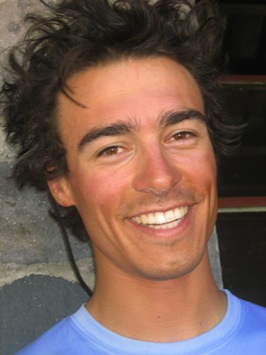
David Ayala is a theoretical physicist whose work sits at the intersection of quantum physics, topology, and mathematical structures underlying quantum field theory. His research explores how abstract concepts — symmetry, dimensionality, and topology — manifest in physical systems and shape what kinds of particles, interactions, and computational models are possible.
A Different Kind of Protection for Quantum Information
David began by reframing a central problem in quantum computing: how do we protect information stored in quantum states? In conventional approaches, protection relies on redundancy and active error correction. But topological quantum computing proposes something more passive and more radical.
The idea is to encode information not in local properties of particles — such as spin orientation at a point — but in global features of a system. These features cannot be changed by small, local perturbations. In the same way that you cannot untie a knot by tugging gently at one strand, topological information is immune to many forms of noise.
This intuition sets the stage for the rest of the talk.
Topology as a Physical Idea
Topology is often introduced mathematically as the study of shapes that remain equivalent under continuous deformation. A coffee mug and a donut are topologically the same because each has one hole. What matters is not exact geometry, but connectivity.
David emphasized that topology enters physics when we ask which properties of a system remain unchanged under smooth, local transformations. In quantum systems, these properties can govern how particles behave, how states evolve, and — crucially — how information can be stored.
Symmetry and the Classification of Particles
Before introducing topological particles, David took a step back to review how particles are classified more generally. In three-dimensional space, particles fall into two familiar categories:
- Bosons, whose wavefunctions remain unchanged when particles are exchanged
- Fermions, whose wavefunctions acquire a minus sign under exchange
This distinction arises from the symmetry of the wavefunction and has deep consequences for physical behavior, from superconductivity to the structure of matter itself.
Why Two Dimensions Change Everything
The story changes dramatically in two-dimensional systems. In two dimensions, particle exchanges are no longer limited to a simple swap. Instead, one particle can wind around another in distinct ways, and these paths cannot always be continuously deformed into one another.
This additional freedom leads to new kinds of particle statistics — particles known as anyons.
Anyons are neither bosons nor fermions. Instead, exchanging them alters the quantum state in a more general way, often described by a phase or even by a transformation within a multi-dimensional state space.
Abelian and Non-Abelian Anyons
David distinguished between two classes of anyons:
- Abelian anyons, where exchanges introduce phase factors
- Non-Abelian anyons, where exchanges act as matrix operations on a degenerate state space
Non-Abelian anyons are especially important for quantum computing because the order of exchanges matters. Exchanging particle A with B, then B with C, can produce a different result than performing those exchanges in another order.
This non-commutativity is the mathematical heart of topological quantum computation.
Braiding as Computation
In topological quantum computing, computation is performed not by applying pulses or gates at specific locations, but by braiding anyons around one another. Each braid corresponds to a transformation of the quantum state.
Because the result depends only on the topology of the braid — not the precise path taken — the computation is inherently robust against local errors.
David emphasized that this is not just a metaphor: the braids are the gates. The geometry of worldlines in spacetime encodes the computation itself.
Fault Tolerance Built into Physics
This is where topology offers its most striking promise. In conventional quantum computers, fault tolerance must be engineered through layers of error correction. In a topological quantum computer, fault tolerance is built into the physics.
Local noise may slightly deform a braid, but as long as the topology of the braid is unchanged, the computation remains correct. This provides a natural protection mechanism that does not require constant measurement and correction.
Universality and the Fibonacci Anyon Model
Not all anyonic systems are computationally universal. David discussed the Fibonacci anyon model, a theoretical system in which braiding operations are sufficient to approximate any quantum gate.
This model plays a central role in theoretical work on topological quantum computing because it demonstrates, in principle, that a purely topological system can perform arbitrary quantum computation.
The Physical Challenge
After laying out the conceptual framework, David turned to the hardest part of the story: realizing these ideas in actual materials.
Topological quantum computing requires:
- Two-dimensional systems
- Strong correlations
- Exotic quasiparticles
- Extreme control over temperature and disorder
Candidate platforms include fractional quantum Hall systems, topological superconductors, and engineered heterostructures. Each comes with its own experimental challenges.
David was clear that while the theory is elegant, the experimental road remains long.
Why This Is Still Worth Pursuing
Despite the difficulty, David argued that topological quantum computing remains compelling precisely because it attacks the noise problem at a fundamental level. Instead of constantly correcting errors, it seeks to avoid them by design.
Even partial realizations of these ideas — systems that exhibit some topological protection — could dramatically improve the stability of quantum devices.
Why This Talk Matters for QCORE
This seminar exemplifies QCORE’s mission: connecting deep theoretical ideas to emerging technologies. Topological quantum computing sits at the crossroads of mathematics, physics, and engineering — and while its realization remains challenging, the conceptual framework it provides continues to shape how researchers think about robustness, computation, and the nature of quantum information itself.
Q&A Highlights
Q: Does topological quantum computing eliminate the need for error correction entirely?
David explained that topological protection significantly reduces certain kinds of errors, but it does not eliminate error correction altogether. Topology protects quantum information against local disturbances, because small perturbations cannot change global topological features. However, other sources of error — such as large-scale defects, thermal effects, or imperfect system preparation — still require mitigation. Topological quantum computing should be seen as shifting the burden of error correction, not removing it entirely.
Q: How realistic are current experimental platforms for realizing topological quantum computers?
David was clear that this remains one of the biggest challenges in the field. While there are promising candidate systems — including fractional quantum Hall states and topological superconductors — creating and controlling the required conditions is extremely demanding. These systems must be two-dimensional, ultra-clean, and operated at very low temperatures. The theory is well developed, but experimental realization is still an active and difficult area of research.
Q: Could topological ideas be combined with more conventional quantum computing approaches?
Yes. David emphasized that topology does not need to be an all-or-nothing solution. Hybrid approaches — where topological protection is used for certain operations or components while conventional techniques handle others — may offer a more practical path forward. Even partial topological protection can improve stability and reduce error rates in quantum systems.
Q: Is topology a “silver bullet” for quantum computing?
David cautioned against viewing topology as a magic solution. Instead, he described it as a powerful guiding principle. Topology helps clarify which errors matter and which do not, and it reframes how robustness can be built into quantum systems. It changes the way researchers think about protection, but it does not bypass the fundamental challenges of building quantum hardware.
Ask David
Have a question about topology, anyons, or topological quantum computing?
Submit your question, and David may respond in a future QCORE feature.